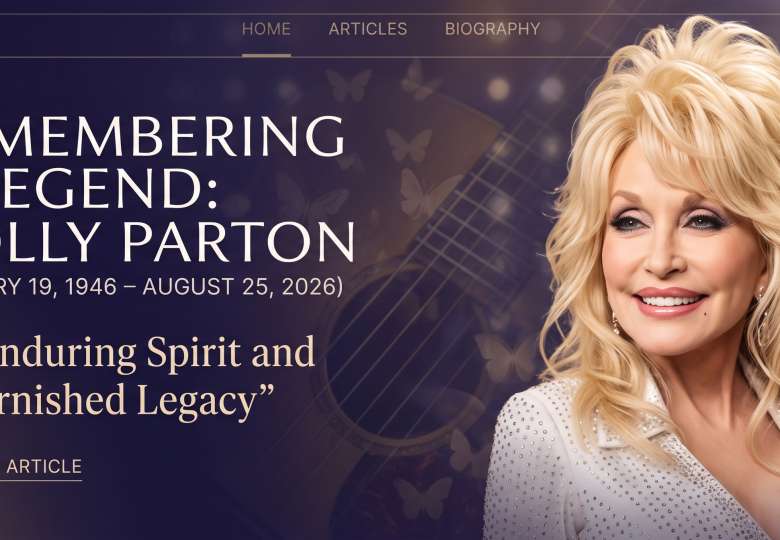
T
he Iron Butterfly: The Music, The Millions, and The Unbroken Legacy of Dolly Parton (1946–2026)
When Dolly Parton passed away on August 25, 2026, at the age of 80, the world did not just lose a country music singer; it lost a pioneering business mogul, a tireless philanthropist, and an architect of modern American pop culture. Following a brief battle with cancer, she passed peacefully at the Vanderbilt-Ingram Cancer Center in Nashville, Tennessee—the very same institution she had quietly supported for years, most notably through her pivotal million-dollar donation that helped fund the early development of the Moderna COVID-19 vaccine.
A few weeks later, at the Emmy Awards in September 2026, her Steel Magnolias co-star Sally Field stood before a tearful audience to introduce the “In Memoriam” segment. Calling her a “real giant” and an “angel on Earth,” Field’s tribute perfectly captured the dual nature of Parton’s legacy: a woman of profound, down-to-earth empathy who possessed a towering, unstoppable intellect.
Parton’s life is a masterclass in the American Dream, charting an impossible trajectory from a one-room dirt-floor cabin in the Great Smoky Mountains to the highest echelons of international superstardom. She was a woman who hid her ruthless business acumen beneath towering blonde wigs, acrylic nails, and a hyper-feminine aesthetic, famously quipping, “It costs a lot of money to look this cheap.” But beneath the rhinestones was a prolific songwriter who penned over 3,000 original compositions, a shrewd negotiator who guarded her intellectual property with ironclad resolve, and a visionary who single-handedly transformed the economy of her native East Tennessee. This is the comprehensive story of Dolly Rebecca Parton.
The Smoky Mountain Genesis (1946–1964)
Dolly Rebecca Parton was born on January 19, 1946, in a one-room cabin nestled on the banks of the Little Pigeon River in Pittman Center, Tennessee. She was the fourth of twelve children born to Avie Lee Caroline and Robert Lee Parton. Her early life was defined by a level of poverty that is difficult to comprehend in the modern era, yet it was infused with an equally deep sense of familial love, faith, and music.
Her father, Robert Lee, was a sharecropper and tobacco farmer who could neither read nor write. Despite his lack of formal education, Parton frequently credited him with possessing the sharpest business mind she had ever encountered, an innate shrewdness she inherited and applied to the global entertainment industry. Her mother, Avie Lee, who married at the age of 15 and gave birth to 12 children by the time she was 35, imbued the Parton household with a rich tapestry of Smoky Mountain folklore, Welsh and Irish ballads, and storytelling.
The story of Dolly’s birth immediately became part of the family’s lore. Because they had no money, her father paid the doctor who delivered her with a sack of cornmeal. This foundational experience of rural poverty would later fuel some of her most poignant songwriting, most notably the autobiographical masterpiece “Coat of Many Colors,” which detailed her mother sewing a coat for her out of rags, only for Dolly to be mocked by her wealthier classmates at school.
Music was not merely a pastime in the Parton household; it was the fabric of their existence. Dolly began her musical journey singing in the Church of God, a strict Pentecostal congregation where her grandfather served as the pastor. The fiery, emotive singing of the church left a permanent mark on her vocal style. Her very first instrument was a makeshift guitar crafted from an old mandolin body and two bass strings. Recognizing her undeniable obsession with music, her uncle, Bill Owens, bought her a real Martin acoustic guitar when she was eight years old.
By the age of ten, Dolly was already a local celebrity. She began performing on regional television and radio shows in Knoxville, Tennessee, making a name for herself on The Cas Walker Farm and Home Hour. Cas Walker, a local grocery store magnate and politician, was known for his tough, abrasive personality, but he recognized a prodigy when he saw one. Under his localized spotlight, Dolly honed her stage presence.
Her uncle Bill, acting as her early manager, began driving her to Louisiana and Nashville to seek larger opportunities. At just 13 years old, she recorded her first single, “Puppy Love,” released on a small Louisiana independent label called Goldband Records. That same year, she made her debut performance at the Grand Ole Opry, where she was introduced by Johnny Cash. Cash pulled the young girl aside and told her to trust her instincts, ignore the industry naysayers, and never give up.
Despite her local fame, Parton knew that achieving true stardom required a permanent geographical leap. In 1964, on the exact morning after she graduated from Sevier County High School—the first in her family to do so—she packed her meager belongings into dirty paper bags and boarded a bus to Nashville.
The Nashville Crucible and Combine Publishing (1964–1967)
Parton’s arrival in Nashville was marked by an immediate, life-altering encounter. On her very first day in the city, while doing her laundry at the Wishy Washy laundromat, she met Carl Thomas Dean. Dean, who ran an asphalt road-paving business, was entirely disinterested in the entertainment industry and famously shunned the spotlight. The two fell in love and married in 1966. Their marriage, which lasted over half a century until her passing, provided the quiet, grounding foundation that allowed Parton’s massively public, high-octane persona to thrive.
Initially, Dolly found success in Nashville not as a singer, but as a behind-the-scenes songwriter. She and her uncle Bill signed with Combine Publishing. She quickly proved her worth by penning hits for established artists. Her first major success was “Put It Off Until Tomorrow,” recorded by Bill Phillips in 1966, which went to number six on the country charts. Parton provided uncredited harmony vocals on the track, and radio DJs began fielding calls asking who the girl with the striking, angelic voice was.
She was eventually signed to Monument Records by Fred Foster. However, the label executives drastically miscalculated her appeal, attempting to market her as a bubblegum pop singer. Her early pop-oriented singles flopped. It wasn’t until she pushed back and recorded a country track, “Dumb Blonde” (one of the few early hits she did not write herself), that she finally cracked the country top 25 in 1967. The success of “Dumb Blonde” forced the label to let her record country music, setting the stage for her mainstream breakthrough.
The Porter Wagoner Era and The Price of Fame (1967–1974)
In 1967, country music entertainer Porter Wagoner was looking for a new “girl singer” for his weekly syndicated television program, The Porter Wagoner Show, following the departure of his previous co-star, Norma Jean. He offered the position to the 21-year-old Parton.
The partnership with Wagoner was the catalyst that catapulted Dolly into millions of living rooms across America, making her a household name in country music overnight. They recorded a string of wildly successful duet albums, dominating the country charts with hits like “The Last Thing on My Mind” and “Please Don’t Stop Loving Me.” They were named the Country Music Association’s Vocal Duo of the Year in 1968, 1970, and 1971.
However, the professional marriage was deeply fraught. Wagoner was notoriously controlling of their business arrangements, the show’s creative direction, and even the stylistic choices Parton made. While she was grateful for the immense platform he provided, Dolly’s solo aspirations were rapidly outgrowing the confines of the duo.
By 1970, she scored her first solo number-one hit with “Joshua.” This was followed by a staggering string of iconic solo tracks that cemented her reputation as one of the greatest songwriters of her generation. In 1971, she released “Coat of Many Colors,” and in 1973, she released “Jolene.” The latter, a desperate, driving plea to a beautiful bank teller who had allegedly been flirting with her husband Carl, showcased Parton’s ability to blend raw vulnerability with an infectious, commercial melody.
By 1974, Parton knew she had to leave the show to forge her own path. Wagoner furiously opposed her departure, leading to intense arguments and legal threats. Realizing that standard negotiations were failing, Dolly turned to the one tool that had never failed her: her songwriting.
She went home, wrote a song, walked into Wagoner’s office the next day, and asked him to sit down and listen. She sang “I Will Always Love You.” The song was not a romantic ballad, but a professional farewell—a statement of immense gratitude coupled with an unbreakable boundary. Wagoner was reportedly moved to tears and agreed to let her go, provided he could produce the record. Released in 1974, it became a massive number-one hit and marked her final liberation from Wagoner’s shadow.
The Art of the Pen: Songwriting and Publishing Mastery
Dolly Parton’s legacy is anchored by her relentless, almost compulsive songwriting process. With a catalog of over 3,000 songs, she possessed a unique ear for turning mundane, everyday occurrences into musical gold.
Her process was entirely organic. She drew inspiration from her immediate surroundings, often utilizing the objects at hand when a guitar was not available. During the filming of the 1980 movie 9 to 5, Parton would walk around the set observing the environment. To create a rhythm for a new song she was conceptualizing, she rubbed her long, acrylic nails together. The sound resembled a clacking typewriter. This organic, impromptu rhythm literally became the opening percussion track of the recorded song “9 to 5,” and Parton was officially credited on the album liner notes for “Nails by Dolly.”
But Parton’s true genius was not just in writing the songs; it was in owning them. While many artists in the 1960s and 70s willingly signed away their publishing rights in exchange for a record deal or radio exposure, Parton actively protected her intellectual property from day one.
In 1967, she founded Owepar Publishing with her uncles. By establishing a publishing company right as she was entering the Nashville mainstream, she secured control over the rights to her earliest hits. As her solo career expanded, she continued this strategy by founding Velvet Apple Music, which published the vast majority of her self-penned hits throughout the 1970s and beyond, including “Touch Your Woman,” “The Bargain Store,” and “Two Doors Down.”
By operating her own publishing companies, Parton ensured that the lion’s share of royalties from radio play, record sales, sheet music, and synchronization licenses flowed directly into her accounts, rather than to a third-party corporate publisher.
This fierce independence was put to the ultimate test in 1974. Shortly after her original version of “I Will Always Love You” reached number one, Elvis Presley decided he wanted to record a cover of the song. Parton was ecstatic and was scheduled to attend the recording session. However, the night before the session, Presley’s notoriously ruthless manager, Colonel Tom Parker, contacted Parton with an ultimatum: Elvis did not record any song unless the songwriter signed over 50 percent of the publishing rights to his estate.
During that era, surrendering half of a song’s royalties was a standard concession many writers gladly made for the immense career boost of having the King of Rock and Roll sing their work. But Parton recognized that the publishing rights to her most personal song were her long-term financial security. She informed Parker that she relied on her copyrights to support her extended family and flatly refused. Parker canceled the session. Parton later admitted she cried all night over the decision.
Walking away proved to be the most lucrative business choice of her entire career. When Whitney Houston recorded a soaring R&B arrangement of “I Will Always Love You” for the 1992 film The Bodyguard, it spent 14 weeks at number one on the Billboard Hot 100 and became one of the best-selling singles in music history. Because Parton had held her ground and retained 100 percent of the publishing rights, she earned an estimated $10 million in the 1990s alone from Houston’s cover—money she famously joked she used to “buy a lot of cheap wigs.”
Pop Crossover and Hollywood Superstardom (1975–1989)
Having conquered country music, Parton actively sought a broader audience in the late 1970s. She began producing her own albums and intentionally transitioning her sound toward mainstream pop, much to the chagrin of country music purists. She hired Sandy Gallin, a prominent Los Angeles talent manager, to help orchestrate her crossover.
In 1977, she released “Here You Come Again,” a bubbly pop-country crossover track written by Barry Mann and Cynthia Weil. It was a calculated risk that paid off astronomically. The song spent five weeks at number one on the country charts and reached number three on the Billboard Hot 100 pop chart, earning Dolly her first Grammy Award.
Concurrently, her physical presentation evolved into the campy, hyper-feminine aesthetic she is known for today. The wigs grew larger, the heels higher, and the rhinestones more abundant. This exaggerated appearance was a deliberate, self-aware marketing tool. By playing the role of the “dumb blonde” or the “backwoods Barbie,” she disarmed critics and industry executives, allowing her to maintain total stealth control over her business dealings. She weaponized her femininity, turning herself into an unforgettable, living cartoon character while simultaneously running a multimillion-dollar enterprise.
The 1980s launched Parton into Hollywood. She made her acting debut in the seminal 1980 workplace comedy 9 to 5, starring alongside Hollywood royalty Jane Fonda and Lily Tomlin. Parton not only held her own against the veteran actors, but she completely stole the film. Furthermore, the title track she wrote for the movie became an anthem for the working woman, hitting number one on the pop, country, and adult-contemporary charts simultaneously, and earning her an Academy Award nomination.
She continued her cinematic success with The Best Little Whorehouse in Texas (1982), which included a globally successful re-recorded version of “I Will Always Love You,” and Steel Magnolias (1989), where she played the quick-witted, deeply empathetic salon owner Truvy Jones. Her film career proved her enduring appeal as a magnetic, naturally gifted screen presence who could effortlessly blend comedy with profound emotional depth.
Building an Economic Engine: Dollywood (1986–Present)
While many artists squander their earnings on fleeting luxuries, Parton invested heavily in her roots. In 1986, she made a monumental business pivot. She purchased a major stake in Silver Dollar City, a regional theme park in her native Sevier County, Tennessee, and rebranded it as Dollywood.
Many in the entertainment industry viewed the venture as a highly risky vanity project. Theme parks were notoriously difficult to maintain, and placing one in a rural, poverty-stricken area of the Appalachian Mountains seemed like a guaranteed failure. But Parton understood her audience better than the coastal executives did.
Her primary motivation was not just profit; it was economic stimulation. She wanted to bring stable jobs, tourism, and infrastructure to the struggling region where she grew up. Her gamble paid off exponentially. Today, the Dollywood Company operates the massive theme park, the Dollywood’s Splash Country water park, the DreamMore Resort and Spa, and the HeartSong Lodge & Resort.
Dollywood has grown into the largest ticketed tourist attraction in Tennessee, drawing over three million visitors annually. It is the largest employer in Sevier County, providing thousands of jobs and acting as the central economic engine for East Tennessee. By refusing to abandon her roots, Parton built a billion-dollar hospitality and entertainment empire that completely transformed the financial landscape of her childhood home.
A Heart for the People: The Imagination Library and Philanthropy
Parton always maintained that her immense wealth was merely a tool to uplift others. In 1995, she launched what would become her most passionate and far-reaching philanthropic endeavor: The Imagination Library.
Inspired by her brilliant father’s lifelong inability to read and write, the program was designed to foster a love of reading in preschool children. The concept was simple but revolutionary: the Imagination Library mails one high-quality, age-appropriate physical book per month directly to enrolled children from birth until they enter kindergarten, completely free of charge to the family, regardless of their income level.
What started as a small, localized program for the children of Sevier County rapidly expanded due to its overwhelming success and Parton’s relentless funding. Today, the Imagination Library operates across the United States, Canada, the United Kingdom, Australia, and the Republic of Ireland. As of her passing in 2026, the program had mailed well over 250 million free books to children worldwide, cementing Parton’s legacy as a transformative figure in early childhood literacy.
Her philanthropy extended far beyond books, often acting as a rapid-response safety net for those in crisis. When devastating, historic wildfires swept through Sevier County in 2016, destroying thousands of homes and displacing families, the government response was slow. Parton immediately stepped in, establishing the “My People Fund.” She bypassed bureaucratic red tape and provided $1,000 a month directly to families who had lost their primary residences, sustaining them for six months until they could get back on their feet.
In 2020, during the height of the global pandemic, Parton made a quiet $1 million donation to Vanderbilt University Medical Center. Researchers later confirmed that her specific donation was highly instrumental in funding the critical early-stage research and development of the Moderna COVID-19 vaccine, a medical breakthrough that saved millions of lives globally.
The Modern Icon and Final Chapter (2010s–2026)
In the later decades of her career, Dolly Parton achieved a rare, almost unprecedented level of universal adoration. In an increasingly fractured society, she was one of the few public figures who effortlessly bridged political, generational, and cultural divides. She belonged to everyone.
Musically, she returned to her roots. After conquering pop and mainstream country, she released a series of critically acclaimed, stripped-down bluegrass albums in the late 1990s and early 2000s, including The Grass Is Blue and Little Sparrow, winning a new generation of critical respect. In 2014, she played to a record-breaking crowd of over 100,000 people at the Glastonbury Festival in the UK, proving her enduring global appeal.
In 2022, Parton was nominated for induction into the Rock & Roll Hall of Fame. In a move that perfectly encapsulated her humility and respect for genre boundaries, she initially declined the nomination, issuing a statement that she did not feel she had earned the right to be in a rock hall of fame since she had never made a rock album. When the Hall of Fame voters respectfully ignored her withdrawal and inducted her anyway, she accepted gracefully.
True to her word, she decided that if she was going to be in the Rock & Roll Hall of Fame, she needed to earn it. She immediately went into the studio and recorded her first-ever rock album, Rockstar (2023). The sprawling, ambitious project featured collaborations with musical titans like Paul McCartney, Elton John, Sting, and Stevie Nicks. It proved that even in her late seventies, her creative drive remained completely untamed.
Dolly Parton’s passing on August 25, 2026, marked the end of an era. But her life story defies the simple categorization of a celebrity biography. She was a woman who spun the deep poverty of her childhood into musical gold, who utilized the restrictive gender expectations of her era as a Trojan horse to build a corporate empire, and who used her immense power to ensure that millions of children would never have to grow up without a book in their hands.
She won 11 Grammy Awards (with over 50 nominations), received the Kennedy Center Honors, and was awarded the National Medal of Arts. Yet, when asked how she wanted to be remembered, she consistently pointed away from the glittering trophies and back to the work itself. Dolly Parton’s legacy is a living, breathing testament to the power of a girl with a homemade guitar, an unyielding belief in her own worth, and a heart large enough to embrace the entire world.
Related Posts
Lorem ipsum dolor sit amet, consectetuer adipiscing elit, sed diam nonummy nibh euismod tincidunt ut laoreet dolore magna aliquam erat volutpat. Ut wisi enim ad minim veniam, quis nostrud exerci tation ullamcorper suscipit lobortis nisl ut aliquip ex ea commodo consequat.
Duis autem vel eum iriure dolor in hendrerit in vulputate velit esse molestie consequat, vel illum dolore eu feugiat nulla facilisis at vero eros et accumsan et iusto odio dignissim qui blandit praesent luptatum zzril delenit augue duis dolore te feugait nulla facilisi.
Sed ut perspiciatis, unde omnis iste natus error sit voluptatem accusantium doloremque laudantium, totam rem aperiam eaque ipsa, quae ab illo inventore veritatis et quasi architecto beatae vitae dicta sunt, explicabo. nemo enim ipsam voluptatem, quia voluptas sit, aspernatur aut odit aut fugit, sed quia consequuntur magni dolores eos, qui ratione voluptatem sequi nesciunt, neque porro quisquam est, qui dolorem ipsum, quia dolor sit, amet, consectetur, adipisci velit, sed quia non numquam eius modi tempora incidunt, ut labore et dolore magnam aliquam quaerat.
Voluptatem. ut enim ad minima veniam, quis nostrum exercitationem ullam corporis suscipit laboriosam, nisi ut aliquid ex ea commodi consequatur? quis autem vel eum iure reprehenderit, qui in ea voluptate velit esse, quam nihil molestiae consequatur, vel illum, qui dolorem eum fugiat, quo voluptas nulla pariatur? Duis autem vel eum iriure dolor in hendrerit in vulputate velit esse molestie consequat, vel illum dolore eu feugiat nulla facilisis at vero eros et accumsan et iusto odio dignissim qui blandit praesent luptatum zzril delenit augue duis dolore te feugait nulla facilisi.
- Vulputate velit esse motie consequat vel illum
- Dolore eu feugiat nulla facilisis at vero eros et
- Accumsan et iusto odio dignissim qui blandit
- Paesent luptatum zzril delenit augue duis
- Sed ut perspiciatis, unde omnis iste natus error
- St voluptatem accusantium doloremque
- Vulputate velit esse motie consequat vel illum
- Dolore eu feugiat nulla facilisis at vero eros et
- Accumsan et iusto odio dignissim qui blandit
- Paesent luptatum zzril delenit augue duis
- Sed ut perspiciatis, unde omnis iste natus error
- St voluptatem accusantium doloremque